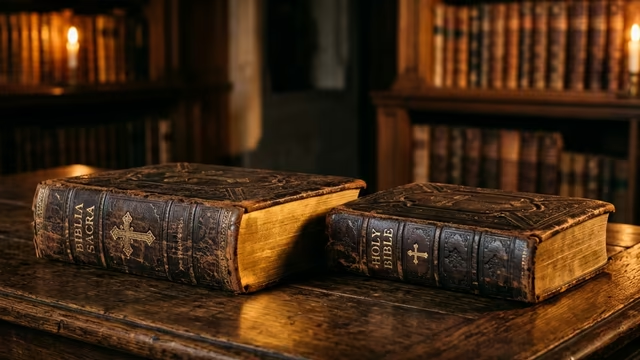
Catholic vs. Protestant Bible
Why are there 73
books?
One of the most common questions for new students of the Bible is: "Why does the Catholic Bible have 73 books, while most Protestant Bibles have only 66?" The answer is not a matter of Catholics "adding" books, but rather a historical decision during the Reformation to "remove" books that had been part of the Christian Canon since the earliest days of the Church.
I. The Septuagint (LXX): The Apostles' Bible
At the time of Jesus and the Apostles, the most widely used version of the Hebrew Scriptures among Greek-speaking Jews (the Diaspora) was the Septuagint. This Greek translation included several books that were not in the later Palestinian Hebrew collection.
When the New Testament authors quoted the Old Testament, the vast majority of their citations (roughly 80-90%) came directly from the Septuagint. The Early Church adopted this collection, including the seven books now called "deuterocanonical," as their official scripture.
"All scripture, inspired of God, is profitable to teach, to reprove, to correct, to instruct in justice." (2 Timothy 3:16) The Early Church understood 'Scripture' to include the full Septuagint.
II. The Early Church Councils
As disputes arose about which books were truly divinely inspired, the Church held several local councils to formalize the list (the Canon). The Council of Rome (382), under Pope Damasus I, followed by the Councils of Hippo (393) and Carthage (397), all listed the same 73 books.
This 73-book canon remained the undisputed standard for over 1,000 years, including through the work of St. Jerome, who translated these books into the Latin Vulgate, which became the definitive Bible of the Western Church.
III. The Protestant Reformation Shift
In the 16th century, Martin Luther and other reformers sought to return to what they believed was a "purified" Hebrew canon. They chose to follow the Masoretic Text—a collection of Hebrew scriptures compiled by Jewish rabbis after the time of Christ—which did not include the seven Greek-language books of the Septuagint.
Luther initially moved these books to an appendix titled "Apocrypha," stating they were "useful and good to read," but not equal to Holy Scripture. Over the subsequent centuries, most Protestant publishers began omitting them entirely to save on printing costs, resulting in the standard 66-book Bible common today.
IV. The Deuterocanon: The Seven Books
The books in question are: Tobit, Judith, 1 & 2 Maccabees, Wisdom, Sirach, and Baruch, along with portions of Esther and Daniel. Catholics call these Deuterocanonical ("Second Canon"), not because they are of secondary importance, but because they were confirmed later in the process of canonization.
These books contain vital theological truths, such as the prayer for the dead find in 2 Maccabees, the intercession of the saints, and beautiful prophecies regarding the Wisdom of God (often seen as a precursor to the Logos in the Gospel of John).
Historical Fact: Every Christian Bible for the first 1,500 years of Christianity—including the Bibles used by the Apostles and the Early Church Fathers—contained these 73 books.
V. Common Questions
Did the Catholic Church "add" these books at the Council of Trent?
No. The Council of Trent (1546) simply reaffirmed the existing canon that had been in use since the 4th century. It was a dogmatic response to the Reformation's challenge, not a new addition.
Does the Dead Sea Scrolls discovery provide insight?
Yes. Fragments of books like Tobit and Sirach were found in Hebrew and Aramaic among the Dead Sea Scrolls at Qumran. This proves these books were indeed part of the religious life of Palestinian Jews before and during the time of Jesus, refuting the claim that they were "late Greek inventions."
Why should I read these books?
They provide the essential "bridge" between the Old and New Testaments. Without 1 & 2 Maccabees, for example, the context for the Feast of Hanukkah (alluded to in John 10:22) is lost. They offer a rich perspective on Jewish hope and suffering in the centuries immediately preceding Christ.